
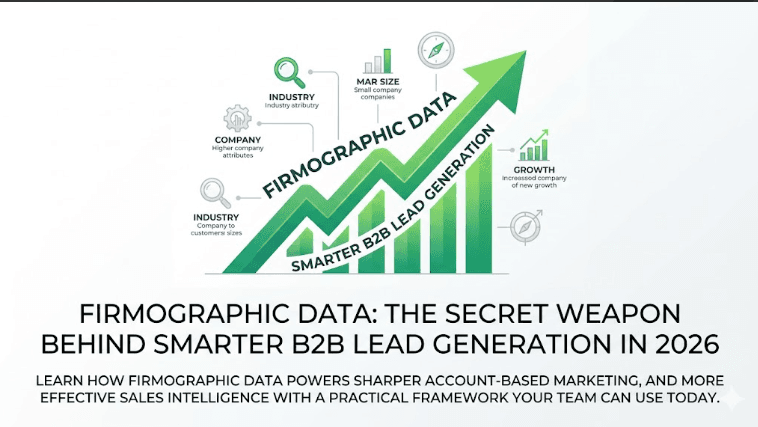
Firmographic Data B2B Lead Generation
Every B2B revenue team is chasing the same goal: reach the right companies, with the right message, at the right time. But most teams are still making targeting decisions based on gut instinct, incomplete records, or lists that were outdated the moment they were exported.
That is where firmographic data changes everything.
Firmographic data is structured, company-level information that tells you exactly what kind of business you are dealing with its size, industry, revenue, location, growth stage, and technology environment. Think of it as the business world's equivalent of demographics, but instead of describing people, it describes organizations. For anyone serious about B2B lead generation in 2026, firmographics are not optional. They are the starting point for every targeting decision worth making.
In this guide, we cover what firmographic data is, why it matters, and how modern sales and marketing teams are using it to build smarter pipelines with a practical framework you can put to work immediately.
What Is Firmographic Data and What Does It Actually Include?
At its core, firmographic data is any structured attribute that describes a company as a business entity. The most commonly used firmographic fields include:
What Is Firmographic Data and What Does It Actually Include? At its core, firmographic data is any structured attribute that describes a company as a business entity. The most commonly used firmographic fields include: Industry and vertical What sector does the company operate in? (Manufacturing, SaaS, Financial Services, Healthcare, etc.) Company size How many employees does it have? This often determines buying authority and budget. Annual revenue A key signal of spending capacity and deal size potential. Geographic location Where is the company headquartered, and where does it operate? Business model Is it B2B or B2C? Enterprise or SMB? A startup or a legacy organization? Funding stage Is the company bootstrapped, Series A, or publicly traded? Technology stack What tools and platforms does it currently use? Growth signals Is it hiring aggressively, opening new offices, or expanding into new markets? Individually, each of these data points is useful. Together, they form a precise company profile that allows sales and marketing teams to make informed, confident decisions about who to target, how to prioritize, and what to say. Why Firmographic Data Is the Foundation of Modern B2B Lead Generation Poor-fit leads are expensive. They consume rep time, inflate pipeline metrics, distort forecasts, and ultimately close at near-zero rates. Most B2B lead generation problems are not volume problems they are targeting problems. And targeting problems stem from a lack of reliable company data. When a team has access to accurate firmographic data, several things change immediately. Targeting becomes precise. Instead of blasting outreach at every company in a category, teams can filter down to accounts that match their ideal customer profile on multiple dimensions simultaneously size, industry, geography, tech stack, and growth stage. The result is a smaller, sharper list that converts at a dramatically higher rate. Lead scoring becomes objective. Most lead scoring models fail because they rely on behavioral signals alone page visits, email opens, content downloads. Firmographic fit adds a foundational layer of qualification that behavioral data cannot provide on its own. A company that matches your ICP on five firmographic criteria is a stronger lead than one that opened three emails but operates in the wrong industry at the wrong size. Personalization becomes scalable. When every account record is enriched with firmographic context, sales reps do not have to manually research each prospect before reaching out. They already know the company's revenue range, the tech stack it runs on, and the growth stage it is in. That context makes outreach feel relevant and informed not generic. Sales and marketing alignment becomes easier. Disagreements between sales and marketing about lead quality almost always come down to undefined targeting criteria. Firmographic data gives both teams a shared, objective language: "We are going after Series B SaaS companies with 100–500 employees in North America using Salesforce." There is no ambiguity in that definition. This is precisely why firmographic data sits at the center of every mature B2B data intelligence strategy. How Firmographic Data Powers Account-Based Marketing in 2026 Account-based marketing has become the dominant B2B marketing strategy for mid-market and enterprise teams, and firmographic data is what makes ABM operationally possible at scale. The premise of ABM is simple: instead of generating volume leads and hoping the right ones convert, you identify a finite list of high-value target accounts upfront and run coordinated, personalized campaigns against them. The challenge is that account selection the very first step has historically been subjective and inconsistent. Firmographic data removes that subjectivity. When you know the firmographic profile of your best customers, you can use that same profile to build your ABM target list systematically. You filter your total addressable market by industry, revenue range, headcount, geography, and technology fit, and the right accounts surface at the top. From there, firmographic segmentation drives the entire ABM program: Tier segmentation becomes data-driven. Tier 1 accounts are those with the strongest firmographic match to your ICP, highest estimated revenue, and most complex buying environments. Tier 2 accounts match on most dimensions but require lighter-touch engagement. Tier 3 accounts are monitored programmatically until they show additional signals. Ad targeting on platforms like LinkedIn uses firmographic filters directly industry, company size, job function to ensure impressions are concentrated on the right accounts rather than wasted on irrelevant audiences. Sales triggers are set based on firmographic and intent signal combinations. When a Tier 1 account in your ICP starts researching relevant topics, a rep gets alerted and a sequence is initiated. Performance measurement shifts from campaign-level metrics to account-level outcomes, segmented by firmographic cohort. This is how ABM teams identify which company profiles respond best and continuously refine their targeting. The result is a marketing and sales motion that feels to the buyer like genuine, informed engagement not a mass campaign. That experience is only possible when the underlying company profiling data is rich, accurate, and current. Sales Intelligence Data: Layering Signals on Top of Firmographics Firmographic data is the foundation. Sales intelligence data builds on top of it. While firmographics tell you what a company looks like, sales intelligence data tells you what that company is doing right now. The most effective B2B prospecting tools combine both layers to surface accounts that are not just a good fit but actively in-market. Here is how the layers stack together: Each layer adds predictive power. A company that matches your firmographic ICP is a good target. A company that matches your ICP, uses complementary tools, and just raised a funding round is a high-priority target. A company that matches all of the above and is actively researching your category right now is a conversation ready to happen. This is why leading revenue teams no longer treat firmographic data as a static list-building exercise. They treat it as a living intelligence layer that, combined with behavioral and event signals, continuously surfaces the accounts most likely to convert in any given week. For teams that want to build this kind of intelligence infrastructure without assembling it from scratch, partnering with a reliablefirmographic data provider is the most efficient path to enriched, accurate, and continuously refreshed company data at scale. A Practical Framework: How to Find B2B Leads Using Firmographic Data Understanding firmographic data is one thing. Operationalizing it is another. Here is a step-by-step framework that works for teams at any stage of maturity. Step 1 Build your ICP from existing customers, not assumptions Pull your top 20 to 30 closed-won accounts from the past 12 months. For each one, document the firmographic attributes: industry, headcount, revenue range, geography, tech stack, and funding stage. Look for patterns. The attributes that appear most consistently across your best customers are the core of your ICP. Step 2 Select a company data platform with the right coverage Your firmographic ICP is only as useful as the database you use to find matching accounts. Evaluate platforms based on data freshness, geographic and industry coverage, attribute depth, compliance with GDPR and CCPA, and native integration with your CRM and sales tools. Step 3 Apply firmographic filters to build segmented lead lists Do not build a single monolithic prospect list. Build separate lists by firmographic segment enterprise vs. mid-market, domestic vs. international, industry vertical by vertical. Segmented lists allow for segmented messaging, which dramatically improves response rates. Step 4 Enrich your CRM with firmographic data Every account record in your CRM should have key firmographic fields populated before any outreach begins. Industry, size, revenue range, and location are the minimum. Tech stack and funding stage are valuable additions. Clean, enriched CRM data is what enables automated lead scoring, routing, and personalization. Step 5 Score leads based on firmographic fit Build a lead scoring model that weights firmographic fit heavily. A company that matches your ICP on four or more dimensions should score significantly higher than one that matches on one or two. Layer in behavioral intent signals to further separate active prospects from passive ones. Step 6 Write outreach that reflects firmographic context Personalization is most effective when it is relevant, not just personal. Referencing a prospect's industry challenge, their growth stage, or the tools they currently use shows that you have done your homework. Firmographic data makes this possible at scale without manual research for every account. Step 7 Measure conversion by firmographic segment and iterate Track open rates, reply rates, meeting rates, and close rates by firmographic segment. Identify which company profiles convert best at each stage of the funnel. Allocate more prospecting effort to high-converting segments and refine or deprioritize segments that consistently underperform. This framework is not a one-time exercise. It is a continuous feedback loop that gets sharper over time as you accumulate more data about which company profiles buy, renew, and expand. What to Look for in a B2B Company Database and Data Intelligence Platform The quality of your firmographic data is only as good as the platform you source it from. Not all business databases for leads are built the same. When evaluating your options, these are the criteria that matter most. Data freshness and update frequency. Company information changes constantly headcount shifts, leadership turns over, companies get acquired or pivot their model. A database that is refreshed quarterly at minimum will give you meaningfully better results than one updated annually. Coverage depth for your target market. A platform may claim tens of millions of company records, but if your target market is mid-size logistics companies in Southeast Asia, the relevant coverage may be thin. Evaluate depth in your specific verticals and geographies, not just total record count. Attribute breadth beyond the basics. Industry and headcount are table stakes. Look for platforms that also offer technographics, funding history, hiring trends, and growth signals. These additional attributes are what separate good targeting from great targeting. Compliance and data ethics. In 2026, GDPR, CCPA, and evolving global data regulations make compliance non-negotiable. Ensure any platform you work with can document its data sourcing practices and provide assurances on regulatory compliance. CRM and stack integration. The best firmographic data is data your team will actually use. Native integrations with Salesforce, HubSpot, Outreach, and other core sales tools reduce friction and increase adoption. Accuracy guarantees. Ask about verified accuracy rates on contact emails and direct dials specifically. Deliverability problems downstream often trace back to data quality problems upstream. Teams that invest in B2B data intelligence as a strategic capability not just a one-time list purchase consistently outperform those that treat company data as a commodity. According to research from Gartner, most B2B buying journeys are now largely self-directed before a prospect ever engages with a sales rep. That means by the time your team gets involved, the window for relevance is narrow. Firmographic intelligence is what ensures every interaction counts. (Gartner B2B Buying Journey Research) Conclusion: Make Firmographic Data the First Investment in Your B2B Stack The most common mistake in B2B marketing and sales is investing in execution before investing in intelligence. Teams pour budget into ads, sequences, and content without first answering the fundamental question: who, exactly, are we trying to reach, and what do we actually know about them? Firmographic data is the answer to that question. It defines your ICP with precision. It powers your ABM account selection. It makes lead scoring objective. It gives your reps the context they need to personalize outreach without manual research. And when combined with intent and trigger signals, it tells you which companies to focus on right now not just in theory. For B2B teams that want to compete seriously in 2026, the message is straightforward: start with the data. Get your firmographic foundation right, and every other investment in your revenue stack will perform better because of it. Frequently Asked Questions Q1. What is firmographic data and how is it different from demographic data? Firmographic data describes companies their size, industry, revenue, location, funding stage, and technology environment. Demographic data describes individual people. In B2B contexts, firmographics play the same role that demographics play in consumer marketing: they help teams identify, segment, and prioritize the right audience. The critical difference is the unit of analysis. B2B purchasing decisions are made at the organizational level, often involving multiple stakeholders, which is why understanding the company profile matters as much often more than understanding the individual contact. Q2. How does firmographic data improve account-based marketing? ABM requires selecting a defined list of high-value target accounts before campaigns begin. Without a data-driven process for that selection, teams default to guesswork, which leads to wasted spend on poorly matched accounts. Firmographic data makes account selection objective and repeatable. By filtering the total addressable market against proven ICP criteria industry, revenue range, headcount, geography, tech stack teams can build tiered account lists that reflect actual buying propensity rather than assumption. Firmographic segmentation then drives personalized messaging for each tier, which is where ABM outperforms traditional demand generation. Q3. Which firmographic attributes matter most for B2B lead generation? The most impactful attributes depend on your product and market, but the attributes with the broadest utility across B2B lead generation programs are: industry or vertical (for product-market fit), employee headcount (for pricing tier alignment), annual revenue (for budget qualification), geographic location (for territory and compliance management), and technology stack (for integration fit or competitive displacement). For companies selling to growth-stage businesses specifically, funding stage and recent hiring signals are also strong indicators of spending readiness and organizational momentum. Q4. How often does firmographic data need to be refreshed? Company data decays quickly. Businesses grow, downsize, pivot, get acquired, or shut down often without any public announcement. Industry research generally estimates that B2B company and contact data degrades at 20 to 30 percent per year. For high-volume outbound programs, outdated firmographic data directly causes deliverability problems, wasted rep time, and inaccurate lead scoring. The best practice is to work with a data provider that refreshes its records at least quarterly, and to schedule CRM enrichment runs monthly so that account records reflect the current state of each target company. Q5. Is firmographic data useful for smaller B2B teams, or only for enterprise? Firmographic data delivers value at every stage of growth. In fact, smaller teams often benefit more than enterprise organizations, because they have less margin for error. A 5-person sales team that prospects only within its firmographic ICP will consistently outperform a 25-person team prospecting broadly without targeting criteria. Most modern company data platforms are designed to scale with usage and offer pricing accessible to startups and mid-size B2B companies. For early-stage teams still finding their ICP, analyzing the firmographic patterns of existing customers is one of the fastest and most reliable ways to identify where to focus prospecting energy next.
Need Expert Business Solutions?
Connect with our experts in IT, Cybersecurity, Software, Digital Marketing, Business Services, and Finance for personalized solutions tailored to your needs.
Get Free Consultation